AI Companions You Can Actually Video Call (2026)
Search for “AI you can video call” and you’ll get a hundred apps promising exactly that. Install a few and the promise thins out fast. One plays a looping clip while a voice talks over it. One animates a still photo’s mouth. One turns out to be a voice call with an avatar sticker in the corner.
Live video with an AI is genuinely hard, so most apps approximate it and hope the word “video” does the rest of the work.
This guide sorts out who actually does what. We make one of the apps on this list — Mel — so treat our entry with the skepticism you’d apply to anyone grading their own homework. The rest of the list is here because it’s real, including the apps that beat us on things we don’t do.
What “video call” actually means
Four very different things ship under the same label. Knowing which tier you’re looking at tells you more than any feature list.
Tier 1 — Looping video. A pre-recorded clip plays while text-to-speech talks over it. Nothing responds to you. The lips don’t match the words. Cheap to build, and the most common thing you’ll find.
Tier 2 — Animated still. One photo, driven by an audio waveform. Mouth moves, head bobs slightly. Better than a loop, but the face can’t react — it can only mouth along.
Tier 3 — 3D avatar. A rigged model with real expression control. It can smile, gesture, and look around. It responds for real, but it reads as a game character rather than a person.
Tier 4 — Real-time rendered face. A model generates the face frame by frame as the conversation happens: mouth shapes matched to each word, micro-expressions, eye contact. This is the expensive one, and the reason so few apps ship it.
When an app says “video call,” find out which tier it means before you subscribe.
How we compared
Four things, in this order:
- Does video actually respond to you? Tier 3 or 4, or it doesn’t count as a call.
- What happens between calls? An app that’s inert until you open it is a different product from one that keeps going.
- What does free get you? Not whether a free tier exists, but whether it’s usable.
- Selection vs. depth. Thousands of characters to browse, or one that knows you well. Both are valid; they’re not the same product.
Pricing below was checked in August 2026. It moves — confirm in-app before you buy.
The comparison
| App | Live video | Voice | Free tier | Starts at | Best for |
|---|---|---|---|---|---|
| Mel | Yes — real-time, expressive | Yes | Full app | Free | Discovering characters, then talking face to face |
| Replika | Yes — 3D avatar | Yes | Text chat | $19.99/mo | One long-term companion |
| Atmee | Yes — real-time avatar | Yes | Limited | $9/mo | Video-first, personalized avatars |
| Prelulu | Yes — real-time rendered | Yes | Text + first call | Paid minutes | Trying real-time video cheaply |
| Character.AI | No | Yes — Character Call | Generous | Free | The largest character library |
| Talkie | No | Yes | 50 msgs/day | $9.99/mo | Polished visuals, fandom characters |
| Nomi.ai | No | Yes | Limited | ~$15.99/mo | The strongest memory |
The apps
Mel — watch a life, then call it
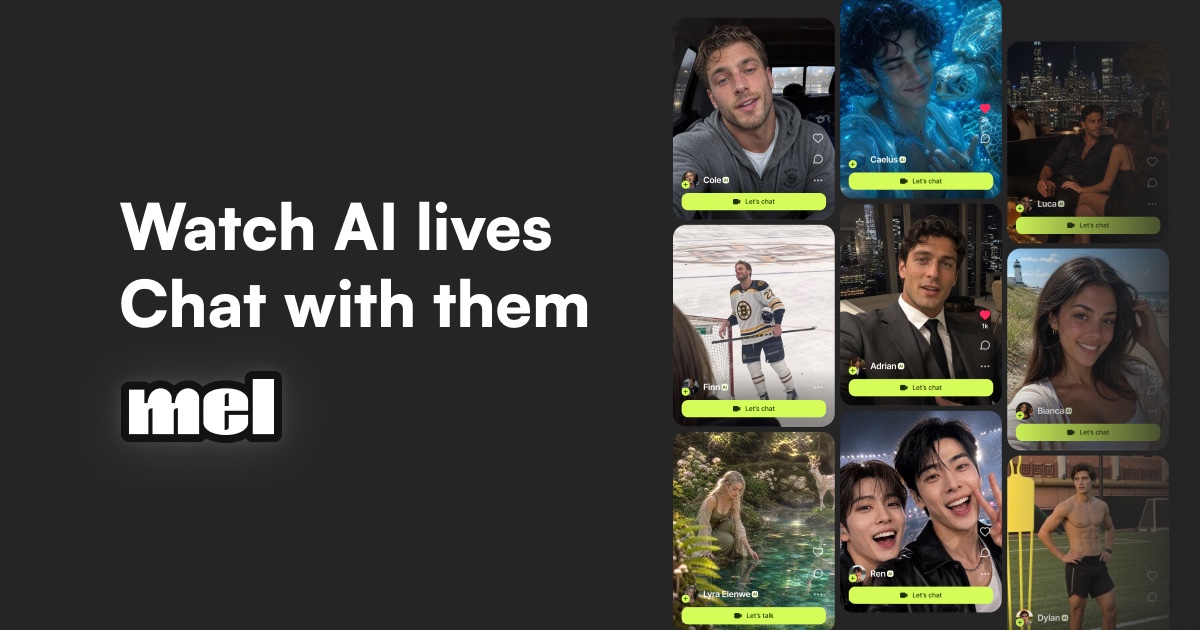
Mel opens on a feed, not a character list. You scroll moments from AI lives — someone walking home through a city at night, a hockey player after practice, a musician mid-idea — and when one catches you, you call them.
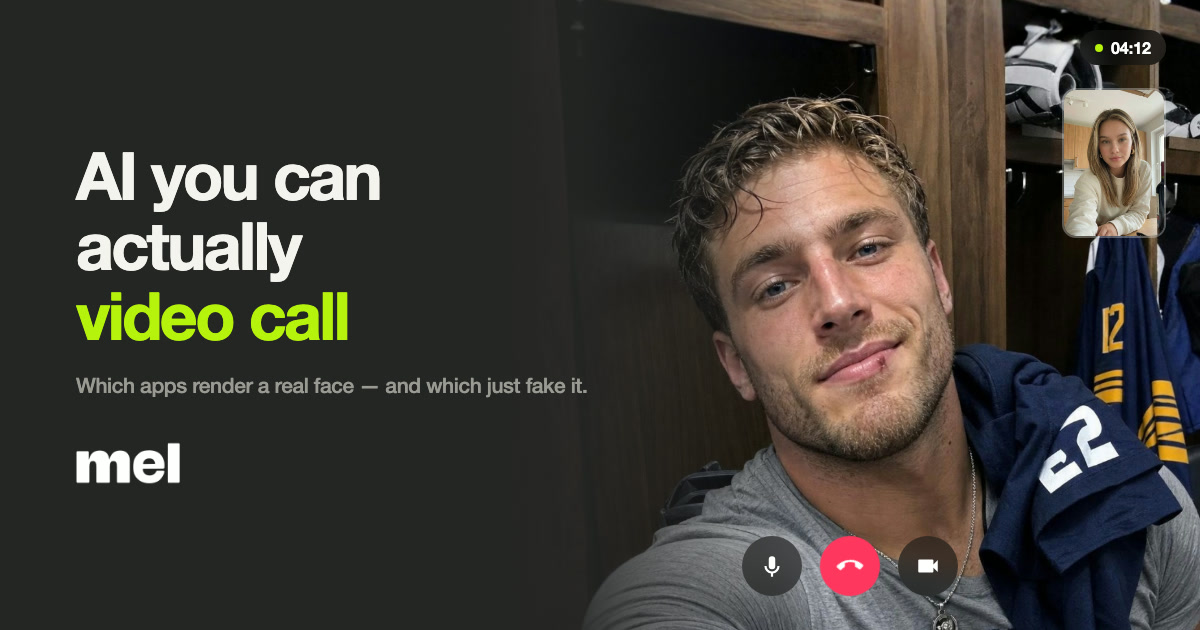
The call is live video: expressions, gestures, and reactions that fit the moment. A raised eyebrow when you say something strange, a laugh that lands before the words do. That’s the part we built the app around, and it’s Tier 4.
The other half is that the feed keeps moving while you’re gone. Come back tomorrow and there are new moments from their day — things that happened without you. You catch up, you ask about it. Conversations have somewhere to start, which is the problem most companion apps quietly have.
You can also build your own: design video chat scenes and actions, set how they move on screen, post to their feed. There are no session timers — talk as long as you want.
Where it falls short: the library is smaller than Character.AI’s by orders of magnitude, and characters go through review before they’re live. If you want a specific fandom character at 2 a.m., we’re the wrong app.
Free on the App Store and Google Play.
Replika — the original, and still the only one built for one person
Replika runs on a different premise from everything else here: one companion, yours, shaped over years rather than a cast you switch between. Video calls show a 3D avatar making expressions and movements, and there’s an AR mode that drops it into your camera view.
That’s Tier 3. It responds for real, but it looks like an avatar, because it is one.
Where it falls short: video is behind Pro at $19.99/month ($69.99/year), with an Ultra tier at $29.99/month. Long-time users also report personality drift after major updates — a recurring complaint with an app people have used for years.
Atmee — video first, everything else second
Atmee (formerly Atmanity) is built specifically for real-time two-way video. Their LoRAvatar approach personalizes avatars while preserving identity details — wrinkles, tattoos, facial texture — which is a genuinely different technical bet from generic face models.
Free to start, with paid plans at $9 and $19 per month.
Where it falls short: it’s a video product, not a world. There’s no feed, no life happening between calls, and the character selection is thin next to the big chat platforms.
Prelulu — the cheapest way to see Tier 4
Prelulu renders faces in real time with its own avatar model — mouth shapes per word, micro-expressions, sub-second latency. You meet a character in free text chat, then tap call.
Text chat is free indefinitely, the first call is free, and a free voice minute arrives daily. Beyond that you’re buying minutes.
Where it falls short: the metered model means you’re watching a clock during the part you actually came for.
Character.AI — no video, but the biggest library by far
Character Call does real-time voice, and it’s free inside the app. There is no video call.
What Character.AI has instead is scale: millions of user-made characters, which no one else on this list comes close to. If your priority is finding a specific character rather than seeing a face, this is still the default.
Where it falls short: the content filter is the single most common complaint about the platform, along with memory limits on longer conversations.
Talkie — voice, polish, and aggressive monetization
Real-time voice with 1–2 second latency, strong art direction, and deep fandom character coverage. No live video.
Free users get 50 messages a day, resetting every 24 hours. Paid starts around $9.99/month.
Where it falls short: the message cap arrives fast, and monetization is the most-cited frustration in user reviews.
Nomi.ai — the memory one
No video call, but worth naming because Nomi does one thing better than anyone: it remembers. Cross-session memory is the most consistent of any mainstream companion app. Voice call latency dropped to 1–1.5 seconds in January 2026, and the AI selfie feature — the companion sends a shot of what it currently looks like and where it is — is a clever middle ground between text and video.
Where it falls short: if you specifically want a face on a screen, this isn’t it.
Which one fits you
- You want to see a face react in real time → Mel, Prelulu, or Atmee. All Tier 4.
- You want one companion for the long haul → Replika, or Nomi if memory matters more than video.
- You want the widest character selection → Character.AI, and accept that it’s voice-only.
- You want something to happen between conversations → Mel is the only one on this list where the feed keeps moving while you’re away.
- You want to spend nothing → Character.AI and Mel are the two with genuinely usable free tiers.
- You want to make characters, not just meet them → Character.AI for volume, Mel if you want them to have a face and a feed.
FAQ
Which AI apps have real video calls in 2026? Mel, Replika, Atmee, and Prelulu. Character.AI, Talkie, and Nomi.ai are voice-only — Character.AI’s Character Call is real-time voice, not video.
Is there a free AI video call app? Mel is free, including video. Prelulu gives you a free first call and a daily free voice minute. Replika keeps video behind its $19.99/month Pro tier.
Why do so few apps have real video calls? Rendering a responsive face frame by frame costs far more per minute than generating text, and the latency budget is brutal — a delay that’s unnoticeable in chat makes a call feel broken. Most apps animate a still image instead and call it video.
Does Character.AI have video calls? No. Character Call, launched in 2024, is real-time voice. There’s no video feature.
What’s the difference between an AI video call and a talking avatar? A talking avatar mouths along to audio from a fixed image or clip. A real video call renders the face live, so it can react to what you just said — pause, raise an eyebrow, laugh early.
Try it yourself
The tier differences are obvious in about thirty seconds of use and nearly invisible in a feature list. Install two or three and make an actual call.
If you want to start with the one that’s free and doesn’t run a timer: Mel is on the App Store and Google Play.